
Thyroid nodules and goiter
Enlarged thyroid, thyroid lumps
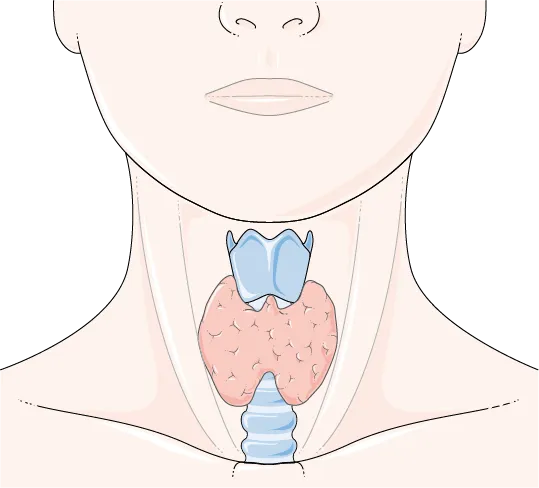
Chronic conditionLumps in the thyroid, or an enlarged thyroid (goiter). They're very common, and about 9 in 10 nodules are benign (not cancer).
Medical Disclaimer
For education only — this guide can't diagnose you. If these signs sound familiar, talk with a healthcare provider. Book a consult
What happens
A nodule is a lump of thyroid tissue that can be solid or filled with fluid. A goiter is an enlarged thyroid, either smooth or made of many nodules (multinodular goiter). Nodules are often found by chance on scans done for other reasons. Ultrasound is the main test, and a scoring system such as TI-RADS uses size and features to decide whether a biopsy is needed. A fine-needle aspiration (FNA) uses a thin needle to collect cells. Some results come back 'indeterminate,' and molecular testing of the sample can help avoid unneeded surgery. Some nodules make extra hormone ('hot' nodules) and can cause hyperthyroidism, but these are rarely cancer.
Who gets it
Nodules are about four times more common in women and become more common with age. By 60, about half of people have one on ultrasound. Low iodine intake and Hashimoto's raise the risk, and nodules can grow during pregnancy. Radiation to the head or neck in childhood, or a family history of thyroid cancer, raises the chance that a nodule is cancer.
Signs worth getting checked
- Often no symptoms at all
- A lump you can see or feel in the front of the neck
- Neck fullness, or collars feeling tight
- Trouble swallowing, or a feeling that something is stuck
- Hoarseness or voice changes
- Cough or shortness of breath, especially lying flat, with a large goiter
- A racing heart, weight loss, heat intolerance, or tremor if a nodule is overactive
Labs to ask about
- TSH
- Thyroid ultrasound, including the lymph nodes in the neck
- Fine-needle aspiration (FNA) if the ultrasound features and size meet guideline criteria
- Molecular testing of the FNA sample if results are indeterminate
- A thyroid uptake scan if TSH is low, to look for an overactive nodule
- TPO antibodies to check for Hashimoto's
Treatments your doctor may discuss
- Watchful waiting with repeat ultrasound for benign nodules
- Surgery for nodules that are cancerous or suspicious, or for a goiter that presses on the windpipe or esophagus
- Radioactive iodine, medicine, or surgery for overactive nodules
- Radiofrequency ablation, offered at some centers, to shrink benign nodules that cause symptoms
- Thyroid hormone to shrink benign nodules is no longer routinely recommended
Supportive steps to discuss with your provider
- Ask for a copy of your ultrasound report and its TI-RADS score, so you can compare future scans.
- Keep follow-up ultrasound appointments, even if you feel well.
- Tell your provider if you had radiation to the head or neck, or have a family history of thyroid cancer.
- Get enough iodine from food, iodized salt, or a prenatal vitamin, but avoid high-dose iodine and kelp.
- Ask whether a known nodule should be rechecked if you become pregnant.
See a doctor promptly if you have
- Trouble breathing, or noisy, high-pitched breathing, with a neck lump: call 911
- Sudden painful swelling in the neck: get same-day care (possible bleeding into a nodule)
- A lump that grows quickly, feels hard, or doesn't move when you swallow
- Hoarseness lasting more than a few weeks, or trouble swallowing
- Swollen lymph nodes in the neck along with a thyroid lump
Related conditions

Ready to find the root cause?
Dr. Lesher is a Naturopathic Doctor who focuses on autoimmune and chronic conditions in women. Since 2020, she's helped hundreds of patients stop managing symptoms and start healing.